This is the question that is quietly spreading through boardrooms, startup offices, and small business WhatsApp groups across the Middle East. Someone used an AI tool and got a website. Quickly. Cheaply. Sometimes in minutes. And then nothing happened.
The Difference Between Generating and Designing
AI can generate a website. What it cannot do is design one.
These are not the same thing, and understanding the difference is the most important thing any business owner can know about digital products in 2026.
Generating means producing output based on patterns. AI tools are trained on millions of websites, design systems, and templates. When you ask them to build a website, they produce something that statistically resembles a website. It has the right components in roughly the right places. It looks familiar because it is built from the average of everything that came before it.
Designing means making decisions. Not producing output — making choices. Choices that are specific to your business, your audience, your market, your goals, and your competitors. Choices that require understanding context, not just recognising patterns.
The gap between those two things is where most AI-generated websites fail.
What AI Cannot Decide
Here is a partial list of the decisions that go into building a website that actually performs — decisions that AI cannot make, because they require understanding that goes beyond pattern recognition:
What your hero section should say. Not just any headline — the specific headline that speaks to the exact fear or desire your best clients have when they first land on your page. Should it lead with a problem or a promise? Should it name your market explicitly or speak more broadly? Should it be a statement or a question? Every choice has implications for who stays and who leaves.
What your CTA should be. The difference between "Get Started" and "Talk to Us" and "Start Your Project" is not cosmetic. Each one signals a different level of commitment, a different type of relationship, a different expectation. The right choice depends entirely on your audience's psychology and where they are in their decision-making process.
What to leave out. This is possibly the most important design decision on any page — and the one AI is least equipped to make. A well-designed website is defined as much by what it does not include as by what it does. Every unnecessary element competes for attention, dilutes the message, and slows the page down. Knowing what to cut requires judgment, not pattern matching.
How to structure your navigation. Navigation is not a list of your departments. It is a map of how your clients think about their own problems. Getting it right requires understanding your clients well enough to model their mental journey — something no AI tool has access to.
What proof to show and where. Should testimonials appear above or below the fold? Should you lead with client logos or results? Should case studies be detailed or brief? Every choice affects how trust is built with a specific audience.
The UX and UI Problem
User experience and user interface design are disciplines that exist precisely because these decisions are hard.
UX — user experience — is the study of how people interact with a product. It involves understanding behaviour, mapping journeys, identifying friction points, and designing flows that guide users towards the actions you want them to take. It is rooted in psychology, research, and iteration.
UI — user interface — is the visual execution of those decisions. Typography, colour, spacing, hierarchy, iconography, motion. Each element communicates something to the user, consciously or unconsciously. A misaligned button, an inconsistent colour, a font that is too small to read comfortably on mobile — each one creates a tiny moment of friction that accumulates into a feeling of untrustworthiness.
AI can produce a UI that looks acceptable. It cannot produce a UX that is deliberately designed for your specific users.
And here is the honest truth that the AI website builder marketing does not tell you: even if you use an AI tool to generate a starting point, producing a website that actually performs requires hours of deliberate decision-making on top of that output. You will spend time adjusting the headline, rewriting the copy, restructuring the navigation, replacing the imagery, refining the layout, testing on mobile, fixing the Arabic version, optimising the load speed.
By the time you have done all of that, the AI tool gave you a starting point — not a finished product. And a starting point built from statistical averages is often a harder starting point than a blank canvas.
How VIVIDA Uses AI
At VIVIDA, we use AI every day. It is embedded in our workflow across prototyping, code generation, content drafting, and iteration.
AI makes us faster. Significantly faster. Projects that would have taken months in a traditional agency workflow take weeks with AI-augmented delivery. We can prototype more quickly, test more directions, and iterate more efficiently than was possible even three years ago.
But AI is our tool. It is not our thinking.
Every decision — about what goes on the page, why it goes there, what it says, how it looks, and how it behaves — is made by a senior team member with over 20 years of experience building digital products for real businesses with real audiences.
The AI accelerates the execution of those decisions. It does not replace them.
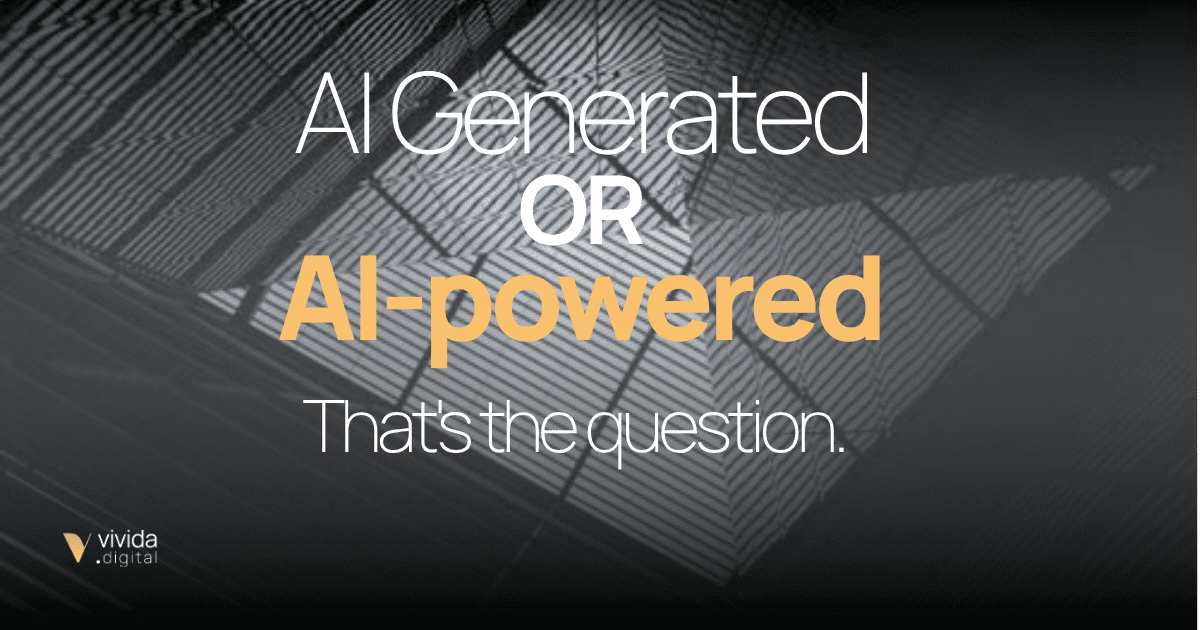
This is the distinction that matters. An AI-generated website is built from patterns. An AI-powered website is built from decisions — executed at speed.
The Question to Ask
If you are considering using an AI tool to build your website — or if you already have and are wondering why it is not performing — ask yourself one question:
Who made the decisions?
Not who generated the output. Not which tool produced the layout. Who decided what to say, how to structure it, what to leave out, and why?
If the answer is "the AI" — you have a generated website. It may look fine. It will not perform like a designed one.
If the answer is a senior team with deep experience in your market, backed by AI tools that accelerate delivery — you have something worth investing in.
Your business deserves a website built on decisions, not defaults.